Board Packaging
NEWS
Don’t evaluate the environmental impact of packaging by material alone. You also need to consider the product being protected, transportation, damage, potential claims, and the wider supply chain.
The cheapest packaging material isn’t necessarily the lowest-cost packaging solution. Likewise, simply minimizing packaging material doesn’t automatically create the most sustainable solution.
The package must protect the product through handling, storage and transportation, and it should use materials efficiently. Once the job is done, packaging materials should have a realistic route to recycling.
Even the EU’s Packaging and Packaging Waste Regulation (PPWR), in force since August 2026, takes this broader view. It calls for packaging to be minimised, but also recognises that packaging must still perform its necessary functions, including protecting the product from damage, deterioration, humidity and other risks.
We have identified four different factors to take into consideration when looking for sustainable choices to package boards to international logistics chains:
1. Less packaging isn’t always more sustainable
If reducing packaging material increases the risk of damaged products, the sustainability is lost. A damaged board also represents wasted raw materials, energy, production and transportation. For example industry guidance for wood-based panels specifically highlights the need to prevent mechanical damage to edges and corners as well as damage caused by wetting and high humidity.
The goal shouldn’t simply be less packaging. It should be the right amount of packaging to protect the value inside.
2. Packaging complexity – More materials don’t necessarily mean better protection
Traditional board packaging can involve several components: covers, straps, protective materials, pallets and plastic film. There may be good reasons for each of them. But sustainability also gives manufacturers a reason to question complexity. Do we need every component? Could the protection be achieved more simply?
Reducing the number of packaging components can also simplify purchasing, inventory, handling and the packaging operation itself.
This question becomes increasingly relevant under PPWR. The regulation requires packaging to move toward recyclability and design for recycling. Its design-for-recycling framework specifically identifies material composition and ease of separation as important parameters. Its design-for-recycling approach is expected to favor mono-materials, or material combinations that separate easily, once the detailed scoring criteria are finalised. The European Commission’s delegated act defining them is due by January 2028.
3. Good product protection is part of sustainability
Packaging is meant to protect the product, but the packaging method itself can cause damage. Straps and banding can affect panel edges or surfaces if the package is not designed and handled correctly.
Plywood and other wood-based panels can be vulnerable to moisture, edge damage, and handling during storage and transportation. That’s why you can’t evaluate packaging sustainability by looking only at the package itself.
Good packaging should help the product arrive in the condition in which it left the mill. For high-value board products, even cosmetic damage can matter when the package reaches the customer. Protecting the product is also about protecting all the resources already invested in making it.
4. What happens to the packaging material after use?
When sourcing and purchasing, always ask: what does the end customer actually want to receive? Six different packaging materials to recycle or just one? The more packaging materials the more to recycle, and when recycling becomes too complex, it doesn’t happen.
Cross Wrap uses stretch film that can be collected and recycled where appropriate collection and recycling systems are available. Protect the product effectively while keeping the packaging process simple.
Don’t forget identification and traceability
A well-protected package still needs identification throughout storage and logistics. Product information, package weight and identification data should remain connected to the package throughout its journey.

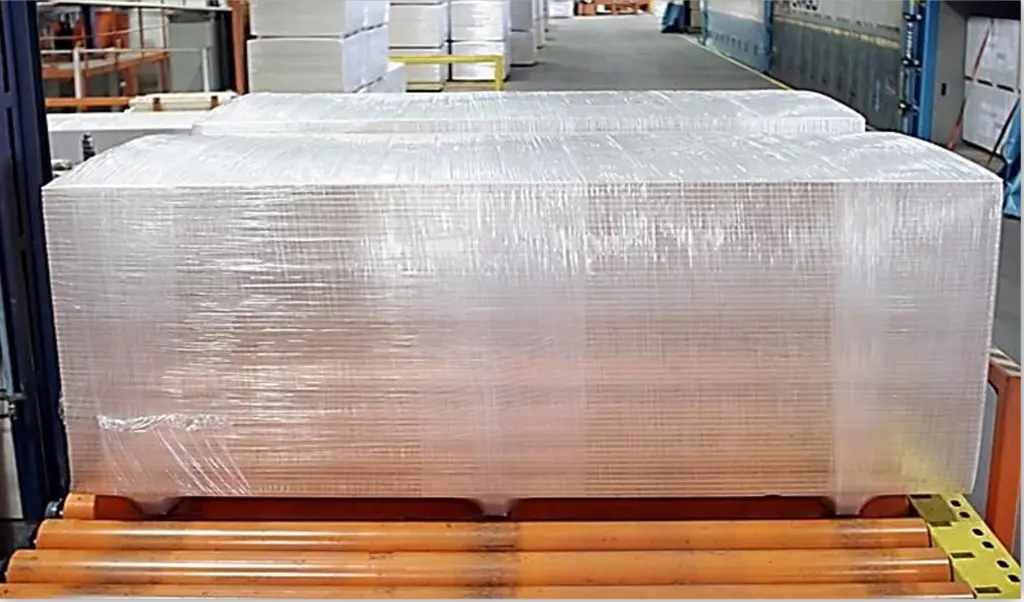
Instead of building the package from many different packaging components, Cross Wrap uses stretch film as the primary packaging material and automatically cross-wraps the board package on all six sides.
Cross Wrap’s simplified, mono-material-focused packaging approach is well aligned with the direction of PPWR – packaging minimisation, recyclability and design for recycling. As PPWR’s detailed criteria are still being finalised, we’re not claiming formal compliance today, but our approach is built for where the regulation is heading.
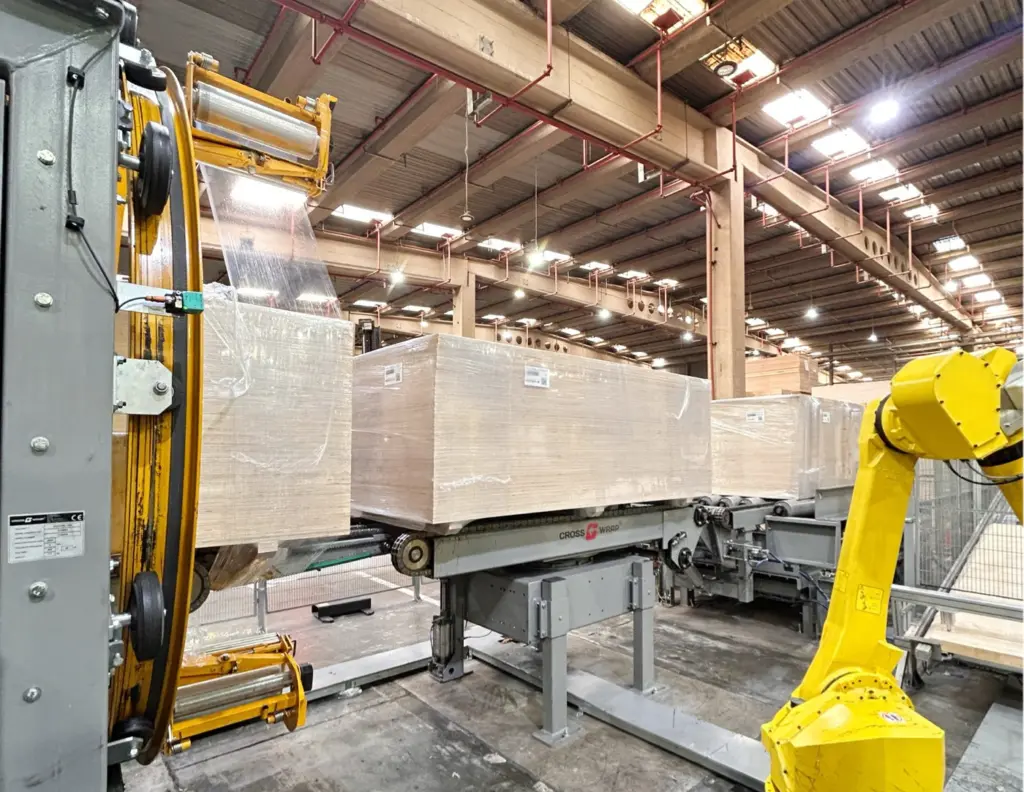
Wrapped on all six sides
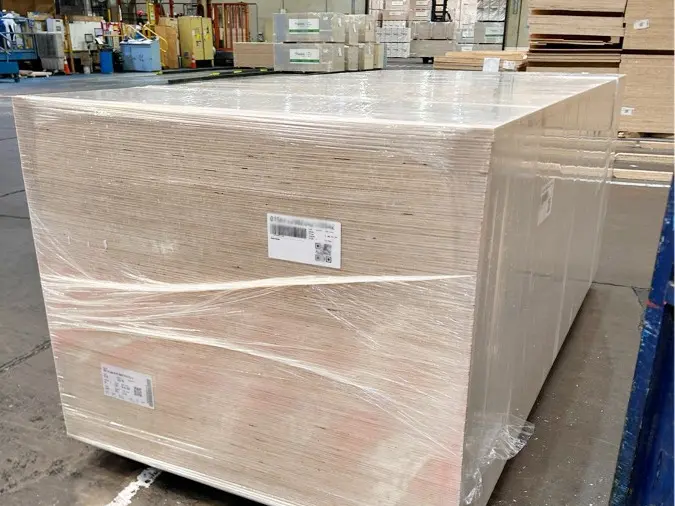
Sealed and ready for export.
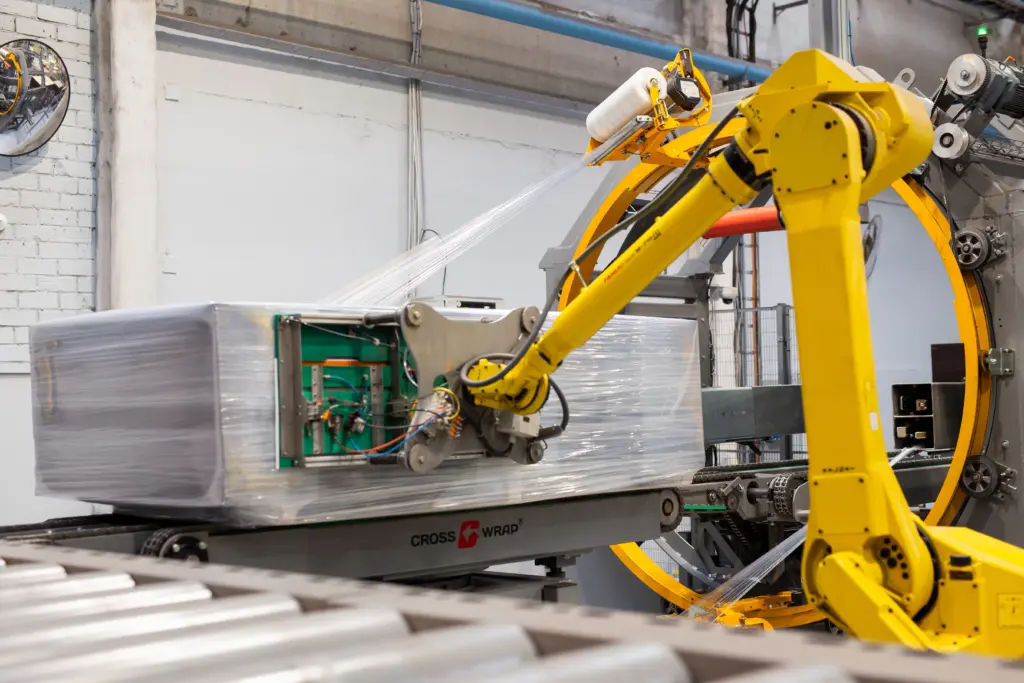
Automated labeling for a professional finish.
Not necessarily. Reducing packaging material is important, but packaging still needs to perform its main function: protecting the product.
For plywood and other valuable board products, insufficient protection can lead to moisture exposure, damaged edges or surfaces, and rejected products. The resources and energy already invested in manufacturing and transporting the product should therefore also be considered.
Even the EU Packaging and Packaging Waste Regulation (PPWR) connects packaging minimisation with maintaining the functionality needed to protect the packaged product.
Because the environmental impact of a damaged product can extend far beyond the packaging itself. Producing plywood or other board products requires wood, energy, processing and transportation. If the product is damaged during storage or transportation, some of those resources may be wasted.
The answer depends on how it is used. Simply replacing plastic with another material does not automatically make a packaging process more sustainable. Material quantity, product protection, transportation, recyclability and what happens to the packaging after use all need to be considered.
In the Cross Wrap solution, stretch film provides six-sided protection while serving as the primary packaging material. The film can be collected for recycling where suitable recycling systems are available.
A package made from several different materials may require more handling and separation after use. The packaging process itself is also complex, and requires manual work.
PPWR’s design-for-recycling framework considers factors such as material composition, compatibility and ease of separation. It specifically points toward mono-material solutions, or material combinations that can be easily separated, as preferable from a recycling perspective.
Cross Wrap automates the packaging process and uses stretch film as the primary packaging material to provide six-sided protection. The concept eliminates the need for several traditional packaging components, such as straps, covers and bottom pallets. It also allows different board and package sizes to be handled with the same automated packaging concept.
PPWR introduces requirements concerning packaging minimisation, recyclability, recycled content and design for recycling, with important requirements being phased in over the coming years. Detailed design-for-recycling criteria are also still being developed.
Cross Wrap packaging concept is well aligned with several key directions of PPWR, including simpler material structures, recyclability, material efficiency and design for recycling. But we cannot claim that Cross Wrap solution is PPWR compliant as the criteria are still in developing phase.
No. PPWR does not simply say “no plastic.” It establishes requirements for packaging more broadly and includes specific measures for plastic packaging, such as recycled-content requirements.
The focus is increasingly on questions such as: Is the packaging necessary? Is its weight and volume minimised? Is it designed for recycling? Can the material actually enter an effective recycling stream? That makes packaging design just as important as material choice.
Instead of looking only at the cost or amount of packaging material, consider the whole process: Does it protect the product? How many packaging components are needed? How much manual work is involved? Can the packaging material be efficiently separated and recycled? Could product damage be reduced? And is the packaging concept ready for changing regulatory requirements?
That gives a much better picture of packaging sustainability than looking at kilograms of packaging material alone.
There isn’t one universal answer. But we believe the direction is clear: protect the product effectively, avoid unnecessary packaging complexity, use materials efficiently, automate where it adds value, and consider what happens to the packaging after use.
Leave us a message, and our expert will get in touch to discuss your case.